
 English
 русский
 Español
 Deutsch
 عربى
عربى
 0
0

How Do You Choose the Best Home Office Shredder for Your Specific Needs?
Content
- 1 Why Every Home Office Needs a Paper Shredder
- 2 The Core Specs That Actually Matter When Choosing a Shredder
- 3 Best Rated Home Office Shredders in 2025–2026
- 4 Side-by-Side Comparison of Top Home Office Shredders
- 5 How to Match a Shredder to Your Specific Home Office Situation
- 6 Common Shredder Mistakes That Shorten Machine Life
- 7 How to Maintain Your Home Office Shredder for Maximum Longevity
- 8 Shredder Safety: Protecting People and Equipment
- 9 The Real Cost of Owning a Home Office Shredder
- 10 Frequently Asked Questions About Home Office Shredders
- 10.1 Can I shred staples and paper clips?
- 10.2 What's the difference between a shredder and a paper disposer?
- 10.3 Are there shredders that also handle wood or organic material?
- 10.4 Is a micro-cut shredder harder to maintain than a cross-cut?
- 10.5 Can I use any oil to lubricate my shredder?
- 10.6 What does "auto-feed" mean, and do I need it?
- 11 Final Verdict: Choosing the Right Home Office Shredder
Bottom line: The best home office shredder for most people is a micro-cut model with a 6–8 sheet capacity, a 20–30 minute run time, and P-4 or higher security level — balancing security, convenience, and affordability. Read on to learn exactly how to match shredder specs to your specific workload, space, and security requirements.
Why Every Home Office Needs a Paper Shredder
Identity theft affects millions of households every year. According to the Federal Trade Commission (FTC), over 1.4 million identity theft reports were filed in the U.S. in 2023 alone — and a significant percentage of cases involved discarded physical documents. Bank statements, medical records, credit card offers, utility bills, and tax forms left in your recycling bin are a goldmine for thieves.
A quality paper disposer — more commonly known as a paper shredder — is no longer just an office luxury. It's a frontline security tool for any home office. Whether you process five sheets a day or a hundred, the right shredder turns sensitive documents into unreadable confetti, permanently eliminating the risk of dumpster diving or mail theft.
Beyond security, shredded paper also reduces bulk in your recycling and can even be repurposed as packing material or compost filler. It's a practical, everyday tool with outsized benefits. If you've ever wondered whether you really need one — you do. The question is simply which one is right for you.
In this guide, we break down everything: security levels, cut types including the critical micro cut vs cross cut shredder debate, run time, sheet capacity, motor power, and the best-rated models available today. We also cover how to maintain your machine for years of reliable use.
The Core Specs That Actually Matter When Choosing a Shredder
Shredder marketing is full of noise. To cut through it, focus on these seven criteria when evaluating any model — from budget strip-cut units to full-power paper shredders heavy duty machines built for sustained daily use.
1. Security Level (DIN 66399 Standard)
The international DIN 66399 standard classifies shredders from P-1 (lowest) to P-7 (highest). Here's what each level means in practice:
- P-1 / P-2: Strip-cut shredders. Long strips that can theoretically be reassembled. Not recommended for sensitive data.
- P-3 / P-4: Cross-cut shredders. Produce small rectangular pieces (~70 mm²). Suitable for personal and home office use.
- P-5 / P-6: Micro-cut shredders. Tiny particles (~30 mm² or smaller). Recommended for financial documents, legal files, and medical records.
- P-7: High-security micro-cut. Used by government agencies for classified materials. Overkill for most home offices.
For most home office users handling tax returns, credit card statements, and medical documents, P-4 or P-5 is the sweet spot. An ideal shredder for home use is typically a micro-cut model at P-5 security.
2. Micro Cut vs Cross Cut Shredder: Which Is Right for You?
The micro cut vs cross cut shredder debate is the most important decision you'll make. Here's the honest breakdown:
- Cross-cut shredders slice paper diagonally in two directions, producing small rectangular confetti. They're faster, quieter, and require less maintenance. A cross-cut model producing pieces at roughly 4mm × 40mm is adequate for everyday home office documents.
- Micro-cut shredders go further, cutting paper into tiny particles (as small as 2mm × 15mm). Reassembling these is practically impossible. If you handle sensitive financial data, client records, or medical information, micro-cut is worth the slight premium.
The practical rule: if you work with financial or legal documents even occasionally, choose micro-cut. If your shredding is purely casual — old grocery lists, junk mail with no personal information — cross-cut saves money and runs faster.
3. Sheet Capacity
Sheet capacity tells you how many pages can be fed at once. Ratings range from 3–4 sheets for basic home units to 20+ for pro-level machines. Choosing too low means constant stop-and-feed cycles; choosing too high means paying for capacity you'll never use.
- Light home use (1–2 people, occasional shredding): 6–8 sheets is sufficient.
- Regular home office use (daily processing): 10–12 sheets.
- Small shared office: 14–20 sheets. Consider a crushershredder machine with a heavy-duty motor.
4. Run Time and Duty Cycle
Consumer shredders overheat and require cool-down periods. Run time is typically 2–10 minutes before a mandatory 20–45 minute rest. Heavy-duty paper shredders for professional settings often advertise continuous run times of 20–60 minutes. Verify this claim in independent reviews before trusting it.
5. Bin Capacity
Bin size determines how often you empty the shredder. Micro-cut shredders produce more volume of waste per page than cross-cut, so if you go micro-cut, opt for at least a 20-liter bin. Many compact models include a 10–14 liter bin, which fills quickly with heavy-duty use.
6. Special Media Compatibility
Modern electronic shredder models go beyond paper. Look for the ability to shred:
- Credit cards and gift cards
- CDs and DVDs
- Staples and paper clips (without pre-removal)
- Small USB drives (some high-end models)
7. Noise Level
Many home shredders operate at 70–80 decibels — comparable to a vacuum cleaner. If your home office is adjacent to living spaces or you take video calls frequently, look for models rated under 65 dB. Premium models from brands like Fellowes or AmazonBasics often publish noise ratings in their specs.
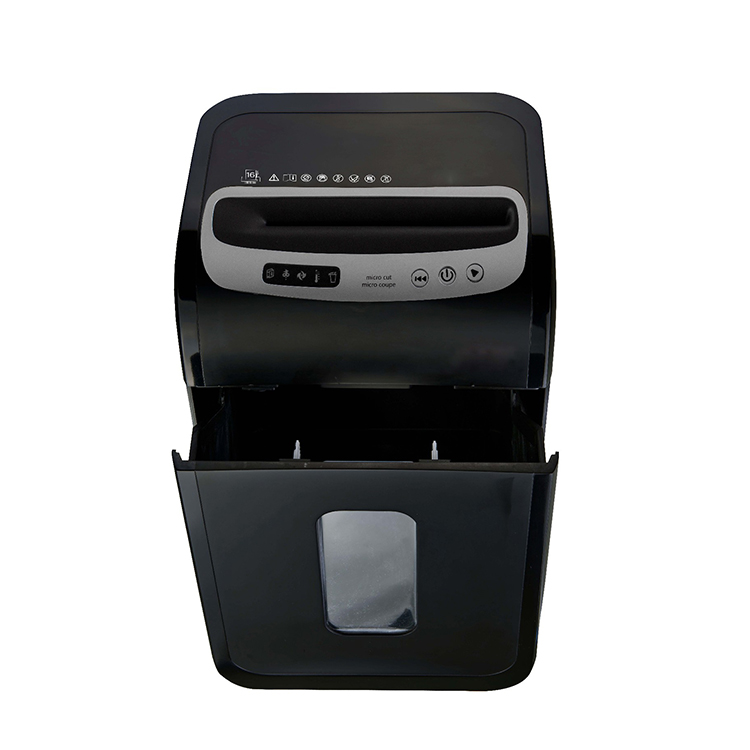
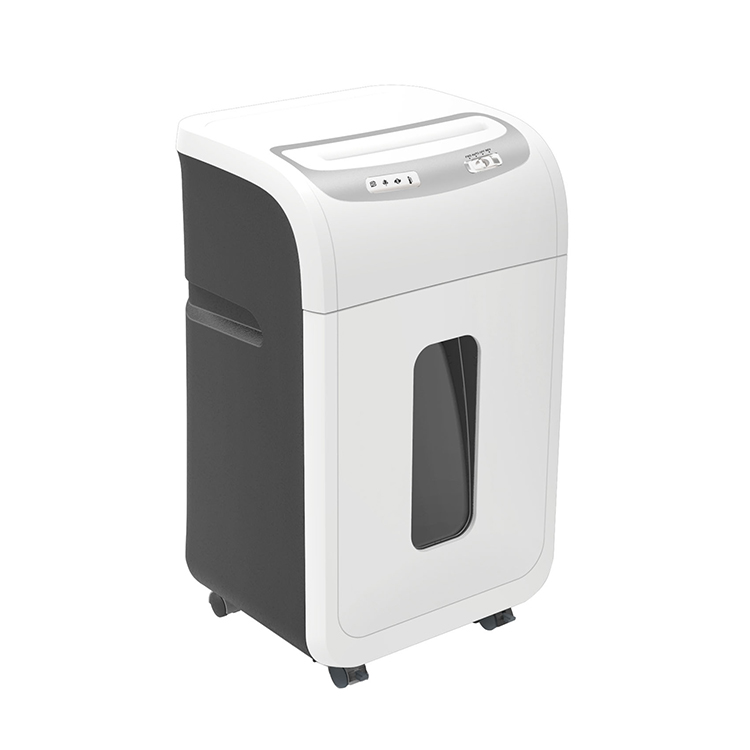
Best Rated Home Office Shredders in 2025–2026
Below are the top-performing shredders across different use cases and budgets. These recommendations are based on aggregate user ratings, independent lab testing, and real-world longevity data. From the humble shredde on your desk to a full pro shredder built for sustained professional workloads, there's a right tool for every need.
Best Overall: Fellowes Powershred 79Ci
The Fellowes 79Ci consistently tops expert rankings for home office use. It offers 12-sheet micro-cut capability at P-4 security, a 16-liter bin, and Fellowes' SilentShred technology that keeps noise under 68 dB. Its SafeSense® system automatically stops the shredder when hands touch the paper opening — a critical safety feature for households with children. Run time is 20 minutes with a 30-minute cool-down. Priced at approximately $149–$179, it represents excellent value.
Best Budget Pick: AmazonBasics 8-Sheet Cross-Cut Shredder
For users who need reliable, no-frills shredding under $60, the AmazonBasics 8-sheet model handles everyday documents, credit cards, and CDs with ease. It's a solid electronic shredder with auto-start/stop functionality and a 4.1-gallon (roughly 15.5 liter) pull-out bin. The cross-cut produces P-3 level security — fine for junk mail and general documents but not ideal for sensitive financial records. Run time is approximately 2 minutes with a 40-minute cool-down, so it's strictly for light use.
Best Heavy-Duty Pick: Bonsaii 14-Sheet Heavy-Duty Shredder (C149-D)
The Bonsaii C149-D is a standout among paper shredders heavy duty models for home offices with serious shredding needs. It handles 14 sheets at once with a continuous run time of 60 minutes and a massive 6-gallon (22.7 liter) bin. Its P-4 cross-cut produces pieces at 5/32" × 15/32", and it handles credit cards, staples, and CDs without issue. At around $95–$115, it's a remarkably powerful machine for the price. Users in professional reviews often use it as a pre shredder machine workflow partner — doing a bulk shred session once a week rather than daily.
Best Micro-Cut for Sensitive Documents: Swingline Stack-and-Shred 80X
If you regularly process tax forms, brokerage statements, or HIPAA-sensitive materials, the Swingline 80X is the closest thing to a genuine pro shredder for home environments. Its auto-feed tray holds up to 80 sheets — you stack your documents, close the lid, and it shreds automatically while you work. P-4 micro-cut security, no manual feeding required. At $225–$280, it's a premium investment that pays for itself in time saved for high-volume users.
Best Compact: HSM Shredstar X8 Personal Shredder
For minimalist home offices or apartment setups where space is at a premium, the HSM X8 packs 8-sheet cross-cut capability into a footprint barely larger than a wastebasket. It operates at a quiet 62 dB, includes a 4.2-gallon bin, and handles credit cards. It's not a crushershredder machine by any measure, but for one or two users doing daily light shredding, it's a refined, reliable choice at under $80.
Side-by-Side Comparison of Top Home Office Shredders
Use this table to quickly compare the key specifications across the models above and find the best fit for your needs.
| Model | Cut Type | Security Level | Sheet Capacity | Run Time | Bin Size | Price (USD) | Best For |
|---|---|---|---|---|---|---|---|
| Fellowes Powershred 79Ci | Micro-Cut | P-4 | 12 sheets | 20 min | 16 L | $149–$179 | Best Overall |
| AmazonBasics 8-Sheet | Cross-Cut | P-3 | 8 sheets | 2 min | 15.5 L | Under $60 | Budget / Light Use |
| Bonsaii C149-D | Cross-Cut | P-4 | 14 sheets | 60 min | 22.7 L | $95–$115 | Heavy-Duty Use |
| Swingline Stack-and-Shred 80X | Micro-Cut | P-4 | 80 sheets (auto) | Auto-feed | N/A | $225–$280 | High-Volume / Sensitive Docs |
| HSM Shredstar X8 | Cross-Cut | P-3 | 8 sheets | ~5 min | 16 L | Under $80 | Compact / Quiet |
Understanding Shredder Categories: From Paper Disposer to Industrial Crusher
It's worth pausing here to note that not all "shredders" are built the same — or even for the same materials. The word "shredder" spans an enormous range of machinery. When you hear terms like woods shredders (designed for garden branches and yard debris), industrial crushershredder machine units (used in recycling plants or manufacturing), or even the term best guitar shredders in an entirely different context (referring to elite guitarists), it illustrates how context-specific the term is.
For the home office, you're squarely in the category of desktop or small floor-standing electronic shredder units powered by an electric motor, designed specifically for paper, credit cards, and optical media. These are distinct from outdoor woods shredders used to chip branches, and from commercial-grade pre shredder machine equipment used in industrial recycling pipelines that process bulk materials before secondary processing. Keeping this context clear helps you avoid buying the wrong product category entirely.
How to Match a Shredder to Your Specific Home Office Situation
Rather than applying one-size-fits-all advice, use this decision framework to narrow your choice based on your real-world situation.
Scenario 1: The Freelancer or Sole Proprietor
If you work from home as a freelancer — graphic designer, consultant, writer, accountant — you likely handle a mix of personal and client documents. Tax records, invoices, NDA agreements, and correspondence with sensitive personal data all pass through your desk. A micro-cut model at P-4 or P-5 with 10–12 sheet capacity is your baseline. The Fellowes 79Ci or a comparable Bonsaii micro-cut unit handles this perfectly. Run time matters too — if you're doing monthly document purges, look for at least 15–20 minutes before requiring cool-down.
Scenario 2: The Remote Employee
If your employer requires you to work with printed company documents at home — contracts, HR files, financial projections — you may actually have a corporate compliance obligation to shred documents securely. Check your company's data handling policy. Many require P-4 minimum, which means cross-cut is often acceptable, but micro-cut is preferred for anything labeled "confidential." An ideal shredder here is one you can include in a reimbursement request to your employer: mid-range models in the $100–$150 range are commonly covered as home office equipment.
Scenario 3: The Small Business Owner (Home-Based)
Running a small business from home — Etsy shop with supplier contracts, therapy practice with session notes, tutoring service with student records — means higher document volume and stricter data obligations. You need a paper shredders heavy duty model with extended run times. The Bonsaii C149-D or Fellowes Powershred 99Ci (20-sheet capacity, 30-minute run time) are purpose-built for this. Consider also an auto-feed model if your monthly purge involves 100+ pages — the time savings add up significantly over a year.
Scenario 4: The Retiree or Household Manager
For households managing medical EOB statements, financial accounts, and social security correspondence, the shredding volume is lower but the sensitivity is high. Here, a compact micro-cut model in the $60–$100 range is ideal. You don't need heavy-duty run time or massive bin capacity — you need reliable P-4 security in a small footprint. The HSM Shredstar X8 or AmazonBasics micro-cut models serve this profile well. Even a basic shredde from a budget brand handles the occasional document purge at this scale.
Multiple adults using the same shredder means higher cumulative daily volume. Factor in children at home and you need robust safety features: auto-reverse when jammed, safety sensors that stop the feed if small hands approach, and a lock-out switch when not in use. Fellowes' SafeSense® technology and AmazonBasics' auto-stop on overload are examples of built-in protections that matter for family use. Capacity-wise, a 10–14 sheet model covers most families without needing a full commercial pro shredder.
Common Shredder Mistakes That Shorten Machine Life
Even the best shredder fails prematurely if misused. Here are the most common errors and how to avoid them.
Overfeeding the Machine
Loading more sheets than the rated capacity is the number-one cause of jams and motor burnout. If your model is rated for 10 sheets, shred 8 to maintain safety margins. This is especially important with paper shredders heavy duty models — their higher capacity ratings are tested under controlled conditions, not continuous overfeed scenarios.
Ignoring the Cool-Down Period
Consumer shredders have thermal overload protection that triggers when the motor overheats. Ignoring cool-down warnings — even when you're in the middle of a big pile — risks permanent motor damage. If your shredder shuts off unexpectedly, unplug it, let it cool for the recommended period (usually 20–45 minutes), then resume.
Skipping Lubrication
Shredder blades need regular lubrication with shredder oil. Neglecting this leads to reduced cutting efficiency, noisier operation, and accelerated blade wear. The general rule: oil your shredder every 30 minutes of run time, or monthly if used lightly. Many manufacturers sell proprietary lubricant sheets that you feed through the machine — they're a simple, mess-free solution.
Shredding Wet or Coated Paper
Glossy magazine paper, sticker backing, and wet documents can gum up blades far faster than standard copy paper. If you need to shred glossy or laminated materials, check your model's specifications first. Many consumer-grade units are not rated for coated stock. Industrial crushershredder machine equipment handles this, but standard home units may not.
Ignoring the Bin Fill Level
Running a shredder with an overfull bin causes shredded material to back up into the cutting head, creating jams and forcing the motor to work against resistance. Empty the bin when it's two-thirds full, not when it overflows.
How to Maintain Your Home Office Shredder for Maximum Longevity
A well-maintained shredder can last 5–10 years or more. Here's a simple maintenance schedule that takes under 10 minutes per month.
Weekly Maintenance
- Empty the waste bin and clean the interior of loose shred particles with a dry cloth.
- Check the feed opening for debris or stuck fragments.
- Wipe down the exterior to prevent dust buildup near ventilation slots.
Monthly Maintenance
- Lubricate the cutting blades with manufacturer-approved shredder oil (about 5–6 drops across the width of the feed entry).
- Run the shredder in reverse for 10–15 seconds after oiling to distribute lubricant evenly across all blades.
- Inspect the power cord for any wear or damage.
- Check that safety features (auto-reverse, jam-clearing function) are responsive.
Annual Maintenance
- Deep-clean the blade assembly with a dry brush or compressed air canister.
- Test the overload protection by intentionally triggering it with an overfeed — verify it stops automatically.
- Review the manufacturer's warranty terms — many require documented proof of proper maintenance for warranty claims.
Dealing with Jams
Even with proper care, jams happen. When they do:
- Stop feeding immediately and switch the machine to reverse mode for 5–10 seconds.
- If that doesn't clear it, power off and unplug the unit.
- Use non-metallic tweezers or a blunt plastic tool to carefully remove the obstruction from the feed entry.
- Never use fingers near the cutting head, even when unplugged.
- Oil the blades after clearing any significant jam before resuming operation.
Chronic jamming usually indicates one of three issues: you're regularly overfeeding, skipping lubrication, or processing materials outside the machine's spec. Adjust your usage habits accordingly, or consider upgrading to a model with higher sheet capacity and a more powerful motor — the kind of throughput that defines a real pro shredder.
Shredder Safety: Protecting People and Equipment
Modern shredders are engineered with multiple safety features, but user behavior matters just as much as product design. Here are the safety principles every home office shredder user should know.
Child Safety
Shredder cutting mechanisms operate at high torque and can cause serious injury if fingers are inserted into the feed slot. If children are in the home, look for models with:
- SafeSense® technology (Fellowes) — sensors that immediately stop the motor when hands contact the paper entry area.
- Key-lock or manual lockout switch — physically prevents operation when the shredder is unattended.
- Auto-off when not in use — reduces the risk of accidental activation.
Never leave a shredder in "auto" mode (where it starts the moment paper is inserted) if young children are nearby.
Fire Safety
Overheated shredder motors are a rare but real fire risk. Always allow the cool-down period after extended use. Never place a shredder directly against a wall or inside a closed cabinet — it needs ventilation clearance of at least 6 inches on all sides. Unplug shredders when not in use for extended periods.
Data Security During Disposal
When you eventually replace your shredder, be aware that the waste bin — and any shredded material remaining in it — still contains document fragments. Empty and dispose of all shredded waste before discarding the machine. For extremely sensitive materials, mix shredded output with water to create a pulp, making reconstruction entirely impossible. This is standard practice for pre shredder machine workflows in secure document destruction companies.
The Real Cost of Owning a Home Office Shredder
Sticker price is only part of the story. Factor in these ongoing costs to understand total ownership expense over a 3–5 year period.
Consumable Costs
- Shredder oil: $8–$15 per bottle, lasting 3–6 months for moderate use. Alternatively, oil sheets cost $12–$20 for a pack of 24.
- Waste bags: Some models require proprietary bags for the bin. Generic alternatives typically fit well and cost $10–$15 for a 100-pack.
Energy Consumption
A typical home shredder consumes 100–400 watts during operation. At average U.S. electricity rates (~$0.16/kWh), running a 200W shredder for 30 minutes daily costs roughly $0.016 per day, or under $6 per year. Standby consumption (when plugged in but idle) adds another $2–$4 annually. Energy cost is not a meaningful differentiator between models.
Replacement Timing
With proper maintenance, expect a quality mid-range shredder to last 5–7 years under moderate home office use. Budget models may degrade significantly after 2–3 years of daily use. Pro shredder models from brands like Rexel or HSM are engineered for 10+ years in office environments. The calculus: paying $180 for a model that lasts 7 years beats paying $50 for one that needs replacement every 2 years — especially when you factor in the time cost of repeated purchasing decisions.
Frequently Asked Questions About Home Office Shredders
Can I shred staples and paper clips?
Many modern shredders — particularly those marketed as paper shredders heavy duty — can handle staples without pre-removal. Very few handle standard paper clips; always remove paper clips before feeding. Check your model's spec sheet explicitly for staple tolerance, as this varies significantly even within the same brand's lineup.
What's the difference between a shredder and a paper disposer?
The terms are functionally interchangeable in consumer contexts. A paper disposer is sometimes used in marketing to emphasize the waste-reduction aspect, while "shredder" emphasizes the security function. Mechanically, they're the same product. Be aware that "disposer" can also refer to kitchen waste disposal units — a completely different product category — so context matters when searching online.
Are there shredders that also handle wood or organic material?
Yes, but these are a completely different product type. Woods shredders (also called garden shredders or chipper shredders) are outdoor power tools designed to process branches, leaves, and garden waste. They share the "shredder" name but bear no mechanical resemblance to office paper shredders. Don't confuse the categories when shopping.
Is a micro-cut shredder harder to maintain than a cross-cut?
Micro-cut shredders have more complex blade assemblies and typically require slightly more frequent oiling. However, the maintenance difference is minimal in practice — both types need regular lubrication and bin emptying. The security benefit of micro-cut far outweighs any incremental maintenance burden for most users.
Can I use any oil to lubricate my shredder?
No. Use only shredder-specific oil (typically a light mineral or vegetable-based oil). Never use WD-40, cooking oil, or general-purpose machine lubricants — these can damage plastic components, attract paper dust, and void your warranty. Canola oil is a widely accepted DIY alternative if you run out of shredder oil, but dedicated shredder oil is always preferred.
What does "auto-feed" mean, and do I need it?
Auto-feed shredders accept a stack of papers in a covered tray and shred them automatically without requiring manual feeding. Models like the Swingline 80X accept up to 80 sheets at once. This feature saves significant time for high-volume users doing monthly document purges. For light users processing a few sheets daily, it's an unnecessary expense — a standard manual-feed model is perfectly efficient.
Final Verdict: Choosing the Right Home Office Shredder
The shredder market spans from a basic $40 shredde that handles occasional junk mail to sophisticated pro shredder workhorses designed for thousands of sheets per month. The right choice comes down to four honest questions:
- How sensitive are my documents? → If financial, medical, or legal: choose micro-cut at P-4 or higher.
- How much do I shred per week? → Under 50 sheets: light-duty; 50–200 sheets: mid-range; 200+: heavy-duty with extended run time.
- Who else is in my home? → Children present: prioritize safety sensors and lockout features.
- What's my budget? → $50–$80: budget options; $100–$180: best overall value zone; $200+: premium auto-feed or commercial-grade.
For the majority of home office users, a micro-cut shredder in the $100–$180 range — such as the Fellowes Powershred 79Ci or a comparable Bonsaii model — delivers the best combination of security, reliability, and long-term value. It's a modest investment that protects you from identity theft, meets corporate data-handling standards, and with proper maintenance, serves you faithfully for years to come.
Don't overthink it. Identify your cut type preference (revisit the micro cut vs cross cut shredder comparison if needed), match capacity to your weekly shredding volume, and prioritize models with at least 15 minutes of continuous run time. Within those parameters, you can't go far wrong.


-
 Kaifat Group, No.599, Qiming Road, Yinzhou Incubation, Ningbo, China
-
 +86-574-55665196
-
 [email protected]
